How to see furniture in your room before you buy it
Quick answer
Measure first, then mark the piece's outline on the floor with masking tape and live with it for a day or two, using boxes to check its height. To judge the look, view it through an augmented reality app or add its product photo to a photo of your room with an AI tool, and check fabric samples in your own light. Use tape for size, pictures for style.

By Eduardo, founder of Calm Decoration
A sofa that looked perfect in the shop can swallow a living room, block a door or turn out a different colour at home. The good news is that you can check almost everything before you buy, with a tape measure, a roll of masking tape and your phone. This guide explains each method, what it shows and what it cannot, and gives you a routine for any large piece.
What should you check before buying furniture?
You need to answer two separate questions: will it fit, and will it look right? Fit is about measurements: the space, the paths around it, the doors and the way into your home. Looks are about scale, style and colour next to everything else in the room.
No single method answers both well. Masking tape is excellent for fit and useless for colour; a picture is excellent for style and only approximate for size. Use one of each.
Measure the room and the piece
- Measure the space where the piece will go: width, depth and, for tall pieces, the height up to any window sill, shelf or sloping ceiling.
- Mark what is in the way: radiators, sockets, switches, skirting boards, a door's swing.
- Measure the piece: width, depth and height from the product page, plus the seat height for chairs and sofas.
- Measure the paths around it. As a rule of thumb, keep about 75 to 90 cm (30 to 36 in) for main walkways and about 40 to 45 cm (16 to 18 in) between a sofa and its coffee table.
- Measure the way in: every door (width and height), the stairs, the turns in the corridor and any lift. For sofas, the shop may list a "diagonal depth" that tells you whether it can be tilted through a doorway.
The sofa size guide and the rug size guide give the rules of thumb for those two pieces.
Mark it out with masking tape
Masking tape on the floor is the simplest and most reliable way to see the size of a piece. Stick down the outline at its exact width and depth, then leave it there for a day or two.
Walk around it, open the doors and drawers near it, sit where you would sit and imagine carrying a tray past. You will quickly notice if a path is too tight or the piece is too big for the wall. For a rug, tape out the whole rectangle and check that the front legs of your seating land on it.
For tall pieces, run tape up the wall too: a bookcase, a headboard or a wardrobe looks very different at 180 cm than at 150 cm.
Mock up the height with boxes
A flat outline does not show bulk. Stack cardboard boxes, or a couple of chairs and a sheet, roughly to the height and size of the piece. Step back to the doorway and look. It is a surprisingly good test for whether a tall cabinet will feel heavy or a high-backed sofa will hide the window.
Draw it to scale
A plan on squared paper, at a scale such as one square for 10 cm, lets you try several layouts in minutes. Cut out the furniture at the same scale and move it around. Many free room-planning apps do the same on screen, and some show the room in 3D.
A plan is the best way to compare layouts, but it does not show what the room will feel like or look like.
See it in augmented reality
Many furniture shops' apps let you place a 3D model of their products in your room through your phone's camera. Point the phone at the floor and the piece appears where you tap, so you can walk around it.
- Good for: a quick sense of size and position from where you stand.
- Less good for: colour and texture, which depend on the screen and the light, and anything outside that shop's own range.
Check the model's size against the product page measurements; it is only as accurate as the data behind it.
Add it to a photo of your room with AI
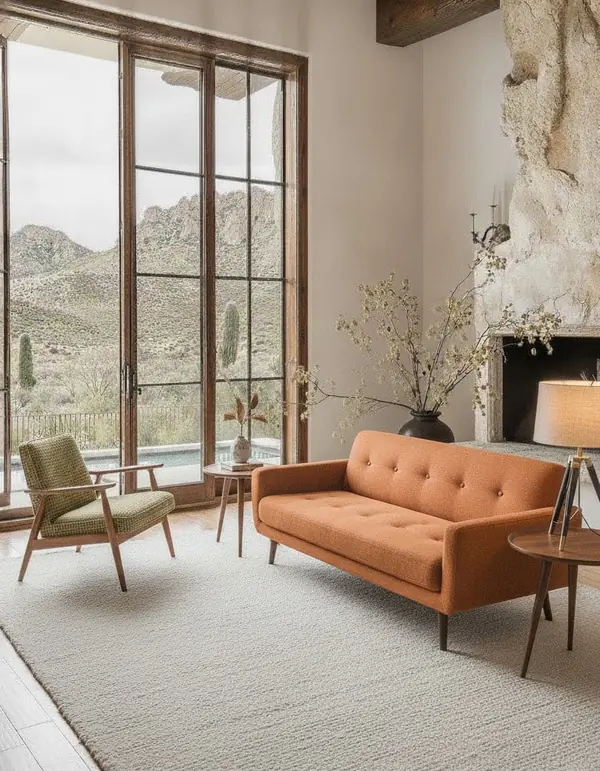
AI tools can draw a piece of furniture into a photo of your own room from its product photo. You see the piece with your walls, floor, light and other furniture, as a finished picture you can look at calmly and show to someone else.
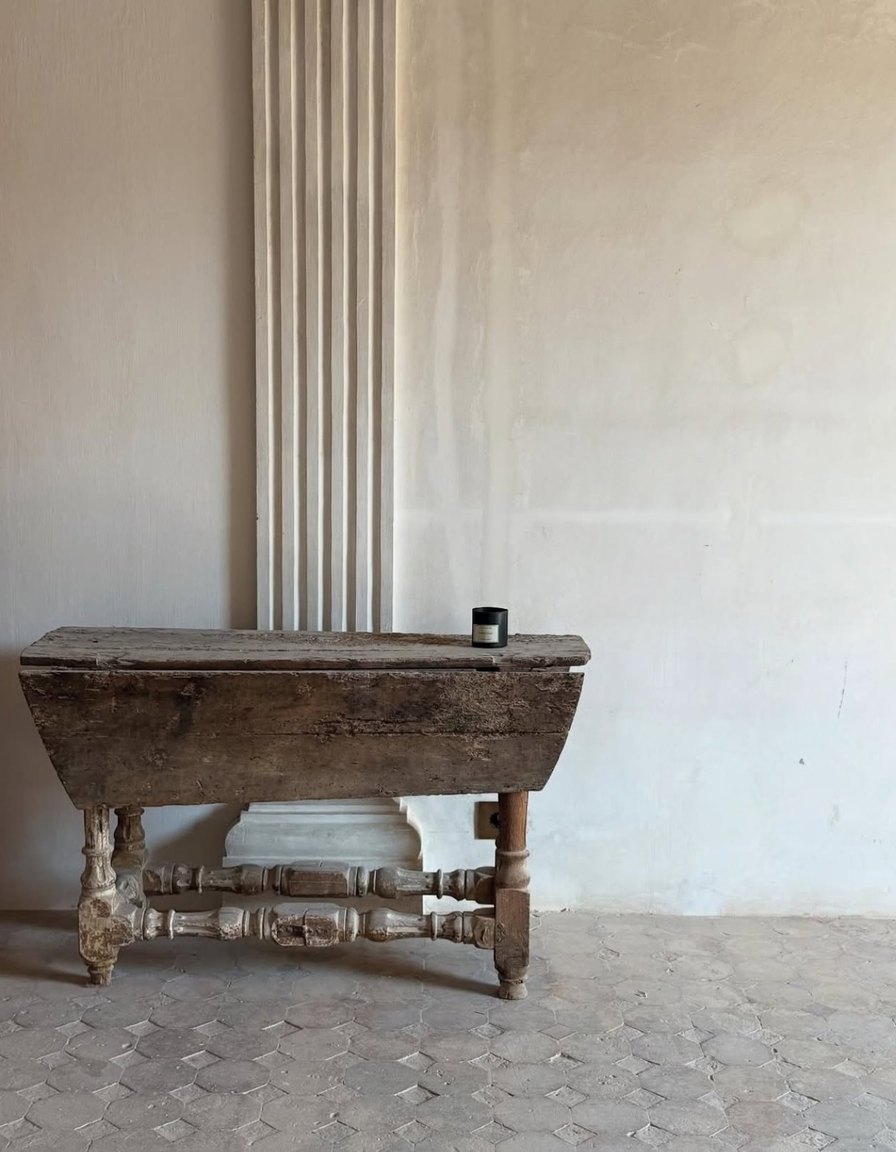
- Good for: judging style, colour and proportion together with the rest of the room, and comparing two or three candidates side by side.
- Less good for: exact size. The piece is drawn to look right, not measured, so it can come out slightly larger or smaller than reality, and details may be redrawn.
This is what Furnish does in Calm Studio: you add the photo of the piece you are considering to a photo of your room, and it is drawn into the space. AI interior design explained covers what these tools can and cannot do, and how to photograph a room shows how to take the photo that gives the best result.
Check colours and fabrics in your own light
Screens and showroom lights both change colours. Order fabric samples or swatches for upholstery, rugs and curtains, and look at them in the room, in the morning, in the afternoon and at night under your lamps. Put them on the floor, against the wall colour and next to the wood they will sit beside.
Which method should you use?
| Method | Shows the size | Shows the look | Effort |
|---|---|---|---|
| Tape measure and notes | Exactly | No | A few minutes |
| Masking tape outline | Exactly, on the floor | No | Ten minutes |
| Boxes for height | Roughly | Bulk only | Ten minutes |
| Plan on paper or an app | Exactly, from above | No | Half an hour |
| Augmented reality app | Approximately | Partly | A few minutes |
| AI on a photo of your room | Approximately | Yes, with your room | A few minutes |
| Fabric samples | No | Colour and texture | Days, for delivery |
A routine before buying a large piece
- Measure the space, the paths and the way in.
- Tape the outline on the floor and live with it for a day or two.
- Check the height with boxes or tape on the wall.
- See the piece in a photo of your room, with an AI tool or an AR app, and compare two or three options.
- Order samples of the fabric or finish and check them in your light.
- Read the delivery and returns terms before you pay.
Check the returns policy
Even with every check, read the returns terms. Made-to-order sofas and custom sizes are often not returnable, and some shops charge for collection. Keep the packaging for a few days after delivery, until you are sure.
Deciding what to check first is easier when you buy in the right order: what to buy first when decorating explains it.
Common mistakes
- Measuring only the space, not the doors and stairs.
- Trusting a picture for size. Confirm with tape on the floor.
- Judging colour on a screen.
- Forgetting the paths, so the piece fits but nobody can walk past it.
- Testing in an empty room, without the rug, lamps and other furniture that will surround it.
Frequently asked questions
Are augmented reality furniture apps accurate?
For size they are usually close, provided the app has the product's real measurements and the phone has scanned the floor properly. Colours and textures are less reliable, so check samples too.
How can I check a sofa will fit through my door?
Measure the door's width and height, and compare them with the sofa's depth, height and, if the shop lists it, diagonal depth. Remember the turns in corridors and stairs, and ask whether the legs come off or the sofa comes in sections.
Can I see a rug in my room before buying it?
Yes. Tape the rug's outline on the floor to check its size against your furniture, and use a photo of your room or a sample to judge its colour and pattern.
Is a picture of the furniture in my room enough to decide?
It is enough to decide on the style and colour, not the size. Always confirm the size with a tape measure and an outline on the floor.