How big should a rug be? A room-by-room size guide
Quick answer
In a living room, choose a rug large enough for at least the front legs of every seat to rest on it, usually 200 x 300 cm (about 6.5 x 10 ft) or larger. Under a bed, it should show 50 to 60 cm on each side and at the foot. Under a dining table, it should reach 60 to 75 cm beyond the table on every side.

By Eduardo, founder of Calm Decoration
This guide is for anyone about to buy a rug and unsure which size to choose. It covers the living room, bedroom, dining room and hallway, how to measure, and the mistakes that make a room feel smaller.
Why does rug size matter so much?
A rug that is too small is one of the most common sizing mistakes in any home, and it shrinks a room. A small rug floating in the middle of the floor breaks the space into islands, while a rug large enough to hold the furniture pulls a seating area or a bed together into one calm group.
The eye reads the rug's edge as the boundary of the zone: if that edge stops in front of the sofa, the sofa looks left out of the conversation.
What size rug for a living room?
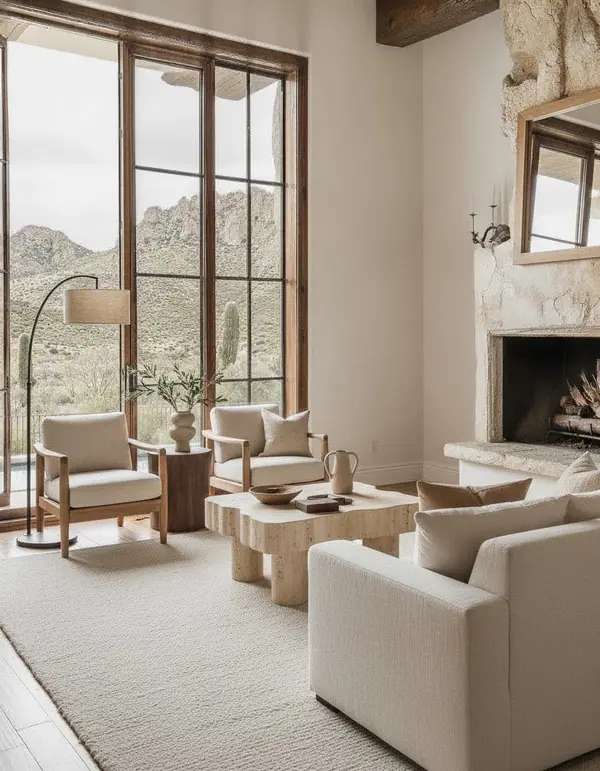
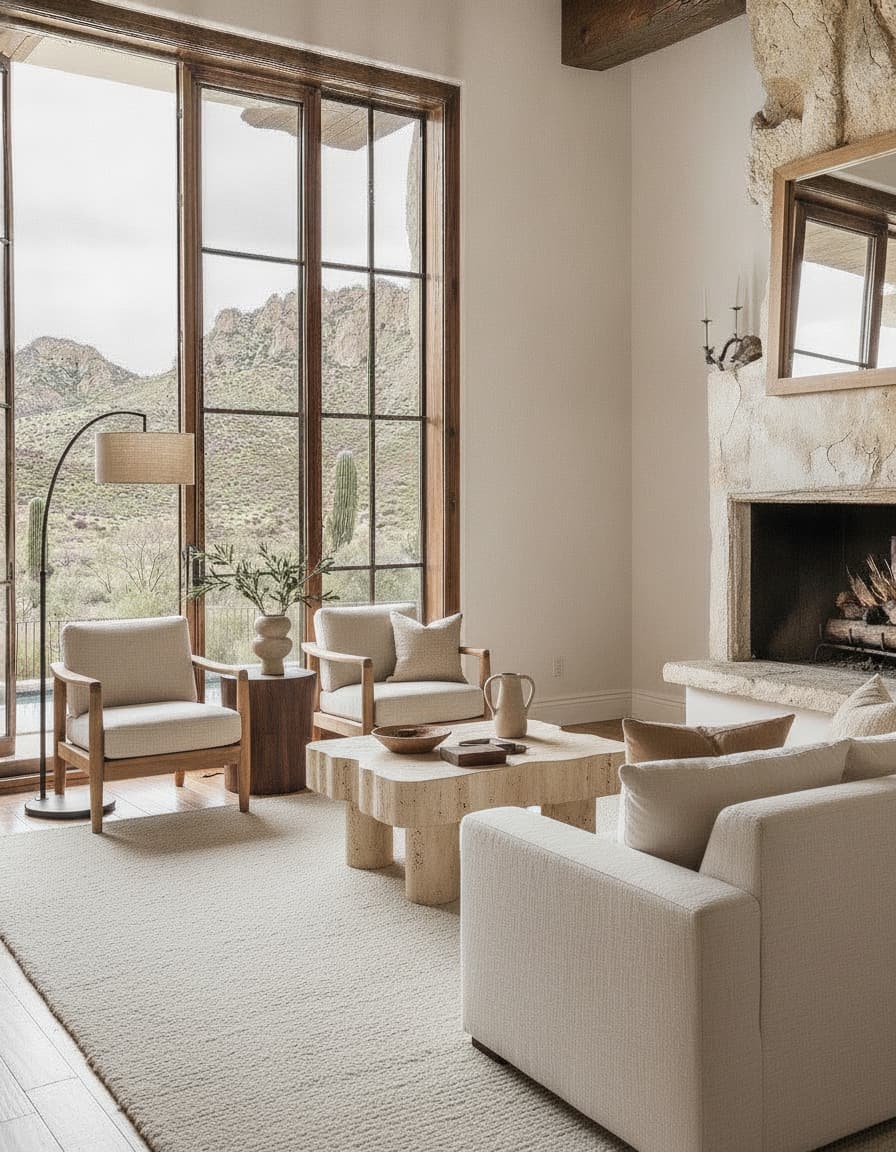
In a living room the rug should be large enough for at least the front legs of the sofa and every armchair to rest on it. For most rooms with a three-seat sofa and one or two chairs, that means 200 x 300 cm (about 6.5 x 10 ft) or 240 x 340 cm (about 8 x 11 ft).
There are three ways to place it, from most generous to most compact:
- All legs on the rug. Every seat sits fully on it. The most generous look, ideal in large or open-plan rooms, where the rug marks out the sitting area.
- Front legs on the rug. Front feet on the rug, back feet on the floor. The most common layout, and it works in almost any room.
- Coffee table only. A smaller rug sits under the coffee table, with no furniture on it. Keep this for very small rooms.
The rug should also be wider than the sofa: let it run at least 15 to 20 cm (6 to 8 in) past each end. A 220 cm sofa therefore needs a rug at least 250 to 260 cm long on that side.
| Your seating | Rug size that usually works |
|---|---|
| Two-seat sofa and one chair, small room | 160 x 230 cm (about 5 x 8 ft) |
| Three-seat sofa and one or two armchairs | 200 x 300 cm (about 6.5 x 10 ft) |
| Large sofa, two armchairs, or two facing sofas | 240 x 340 cm (about 8 x 11 ft) |
| Corner sofa with chairs, or a large open-plan room | 300 x 400 cm (about 10 x 13 ft) |
With a corner sofa, the front legs of both sides should sit on the rug. With two sofas facing each other, the rug should be long enough to reach under the front of both. There is more on these groupings in how to arrange living room furniture.
How much floor should show around a rug?
Leave about 20 to 45 cm (8 to 18 in) of bare floor between the rug and the walls. That border frames the rug the way a mount frames a picture.
In an open-plan room, the rug follows the furniture group rather than the walls.
What size rug goes under a bed?
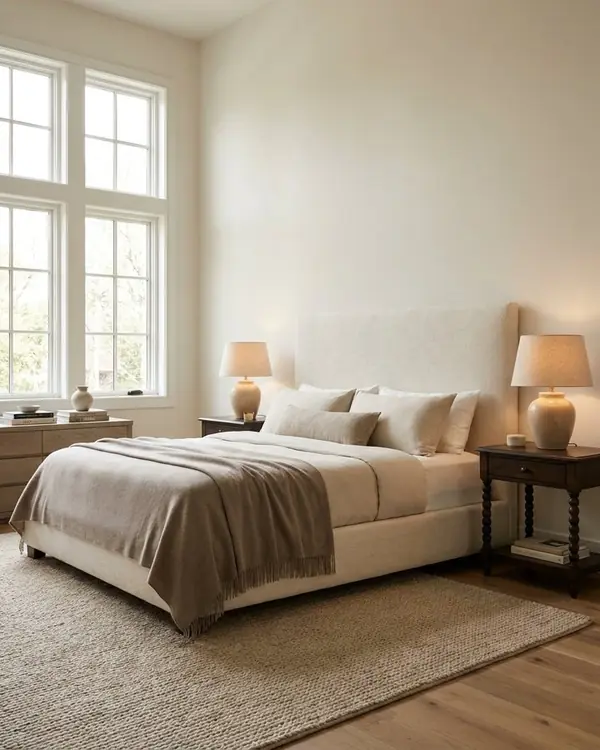
Under a bed, the rug should show 50 to 60 cm (20 to 24 in) of rug on each side and at the foot, so your feet land on something soft when you get up. Lay it across the bed, with its long side running from side to side, then slide it up until 50 to 60 cm shows beyond the foot. With a rug 200 cm deep, the top edge usually ends a little in front of the bedside tables, about a third of the way down the mattress.
| Bed (mattress width) | Rug, laid across the bed | Rug showing at each side |
|---|---|---|
| Single, 90 cm (3 ft) | 160 x 230 cm (about 5 x 8 ft), or 120 x 170 cm beside the bed | about 70 cm |
| Double, 135 to 140 cm (4 ft 6 in) | 160 x 230 cm at the least; 200 x 300 cm is more generous | about 45 cm; about 80 cm |
| UK king, US queen or EU 160, 150 to 160 cm (5 ft) | 200 x 300 cm (about 6.5 x 10 ft) | 70 to 75 cm |
| UK super king, 180 cm (6 ft) | 200 x 300 cm, or 240 x 340 cm | 60 cm, or 80 cm |
| US king, 193 cm (76 in) | 240 x 340 cm, or 9 x 12 ft (274 x 366 cm) | about 75 to 85 cm |
If the room is tight or the bed stands against a wall, two runners, one on each side and about the length of the bed, do the same job. A small rug only at the foot of the bed rarely looks right; it reads as a bath mat. The bedroom layout guide covers the space you need around the bed itself.
What size rug under a dining table?
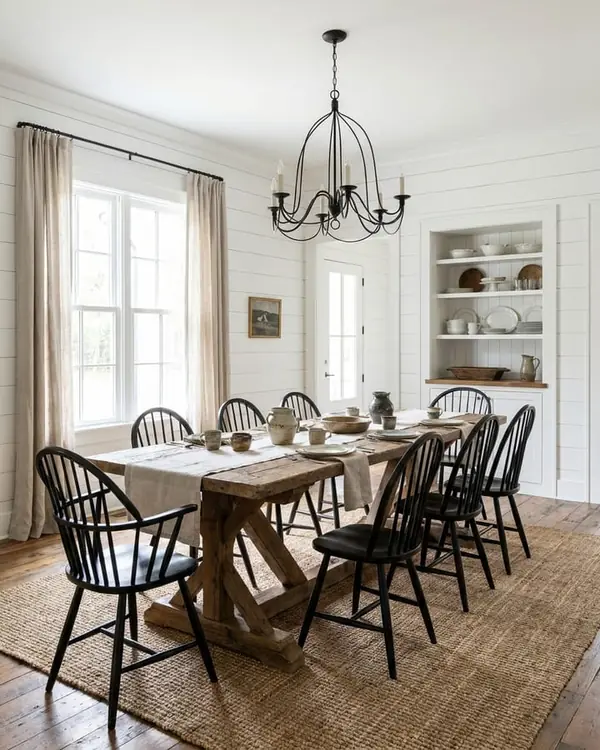
Under a dining table the rug must reach 60 to 75 cm (24 to 30 in) beyond the table on every side, so the chairs stay on the rug when someone pulls one out to sit down.
To find the minimum, add 120 to 150 cm to both the length and the width of the table:
- A table of 90 x 180 cm needs at least 210 x 300 cm, so a 240 x 340 cm rug.
- A table of 100 x 200 cm needs at least 220 x 320 cm, so again 240 x 340 cm.
- A round table of 120 cm needs a round rug of at least 240 cm across.
Match the rug's shape to the table: rectangular under rectangular, round under round. Flat-woven rugs and short piles are far easier to clean under a table than deep shag. The dining table size guide explains how much room the table and chairs need around them.
Hallways, kitchens and entrances
In a hallway, choose a runner that leaves about 10 to 15 cm (4 to 6 in) of floor on each side and stops short of any door, so the doors open freely. At a front door, a rug should be at least as wide as the door opening. In a kitchen, a runner in front of the sink or along a galley run is easier to live with than a large rug, and it should be washable.
How to measure for a rug
Do this before you start browsing.
- Measure the room, wall to wall, and subtract 40 to 90 cm from each dimension for the bare border. That is the largest rug the room can take.
- Measure the furniture group: from the outside of the sofa's arms, and from the back legs of the chairs on one side to those on the other.
- Mark the outline on the floor with masking tape or newspaper, at the size you are considering. Leave it for a day or two and walk around it.
- Check the doors. A thick rug can stop a door from opening over it; measure the gap under any door that swings across the rug.
- Pick the nearest standard size up, not down.
Standard rug sizes
Rugs are sold in a handful of set sizes. Metric sizes vary a little between makers (200 x 290 cm and 200 x 300 cm are both common), so always check the exact measurement.
| Metric size | About, in feet | Typical use |
|---|---|---|
| 60 x 90 cm | 2 x 3 ft | Doormat, bathroom |
| 120 x 170 cm | 4 x 5.5 ft | Beside a bed, small reading corner |
| 160 x 230 cm | 5 x 8 ft | Small living room, under a double bed |
| 200 x 300 cm | 6.5 x 10 ft | Most living rooms, king or queen bed |
| 240 x 340 cm | 8 x 11 ft | Larger living rooms, dining tables for six |
| 300 x 400 cm | 10 x 13 ft | Large or open-plan rooms |
In the United States the common sizes are 5 x 8 ft (152 x 244 cm), 8 x 10 ft (244 x 305 cm) and 9 x 12 ft (274 x 366 cm).
What to do if your rug is too small
Layer it. Put a larger, plain rug underneath, such as jute, sisal or a flat-woven wool in a natural colour, and lay the smaller patterned rug on top. The large rug sets the right scale and the small one becomes the decoration. Natural layering like this sits especially well in a Japandi or other quiet, natural room.
Common rug size mistakes
- Buying a rug that only fits under the coffee table, so all the seating stands around it on bare floor.
- Pushing the rug against one wall instead of centring it on the furniture group.
- A dining rug that stops at the chair legs, so chairs catch on its edge.
To check sizes across the whole room at once, the lesson on getting the sizes right brings rugs, curtains, art and furniture together.
Frequently asked questions
Can a rug be too big?
Yes. If it reaches the walls, or leaves less than about 20 cm of floor, it looks like fitted carpet that does not quite fit. Leave 20 to 45 cm of floor showing all round.
Should the sofa sit on the rug or in front of it?
At least its front legs should sit on the rug. A sofa that stands entirely off the rug, with the rug in front of it, makes the seating look disconnected.
Is a round or a rectangular rug better in a living room?
Rectangular rugs suit most living rooms because sofas and rooms are rectangular. A round rug works well under a round coffee table, in a reading corner or to soften a room full of straight lines.
Do I need an underlay for my rug?
An underlay is worth having on hard floors: it stops the rug from slipping, protects the floor and makes a thin rug feel softer. Cut it slightly smaller than the rug so its edge does not show.