How to choose the right sofa size for your room
Quick answer
A sofa against a wall looks right at about two-thirds of the wall's length, with walkways of about 90 cm (36 in) left around it. Most three-seat sofas are 190 to 230 cm (75 to 90 in) wide and 85 to 100 cm (33 to 39 in) deep. Check seat depth and height for comfort, and measure every door, corridor and stair on the way in.

By Eduardo, founder of Calm Decoration
This guide is for anyone about to buy a sofa, the piece that costs the most, lasts the longest and decides most of a living room's layout. It covers the standard sizes, how big a sofa your room can take, the measurements that make one comfortable, and how to be sure it will get through the front door.
What are the standard sofa sizes?
Sofa sizes vary between makers, but most fall within these ranges. Width is measured from the outside of one arm to the outside of the other.
| Type | Width | Seats |
|---|---|---|
| Two-seater | 140 to 180 cm (55 to 71 in) | 2 |
| Three-seater | 190 to 230 cm (75 to 90 in) | 3 |
| Four-seater or grand sofa | 230 to 270 cm (90 to 106 in) | 4 |
| Sofa with a chaise end | 200 to 260 cm wide, the chaise 140 to 170 cm long | 3 to 4 |
| Corner sofa | Each side commonly 200 to 300 cm | 4 to 6 |
Most sofas are 85 to 100 cm (33 to 39 in) deep overall, with deep, lounging sofas going beyond that, and their backs stand 75 to 90 cm (30 to 35 in) high.
A useful way to judge any sofa is to allow about 60 cm (24 in) of seat for each person, then add the arms. Three people need around 180 cm of seat, so a three-seater with slim arms can be 200 cm wide, while the same seat with deep rolled arms grows to 230 cm or more.
How big a sofa does your room need?
Start from the wall the sofa will stand against, or face. As a rule of thumb, a sofa looks right at about two-thirds of the length of that wall, which leaves space for a side table or a lamp at each end. On a wall of 330 cm, that points to a sofa of about 220 cm.
Then check the floor. Once the sofa is drawn in, you need about 40 to 45 cm in front of it for the coffee table gap, and about 90 cm (36 in) for any main walkway past it. The coffee table size guide gives the table sizes that go with each sofa length.
A sofa should never block a door's swing, stand in front of a radiator, or cut across a window that opens to the floor. If the only way to fit it is to break one of those rules, the sofa is too big for the room.
Which seat depth and height are most comfortable?
Comfort depends more on seat depth and height than on width, and it depends on who will sit there.
| Measurement | Typical range | Go for more if | Go for less if |
|---|---|---|---|
| Overall depth | 85 to 100 cm (33 to 39 in) | You lounge and the room is large | The room is small or narrow |
| Seat depth, front edge to back cushion | 50 to 60 cm (20 to 24 in) | You are tall or like to curl up | You are shorter or like to sit upright |
| Seat height | 40 to 48 cm (16 to 19 in) | Getting up easily matters | You like a low, relaxed look |
| Back height | 75 to 90 cm (30 to 35 in) | You want head support | The sofa stands in the middle of an open room |
The test in a shop is simple: sit right back. Your back should rest on the cushions while your knees bend over the front edge and your feet stay flat on the floor. If your legs stick out, the seat is too deep for you; add a cushion behind you only as a last resort.
Corner sofas, chaises and modular sofas
A corner sofa seats the most people for the floor it takes, and suits family rooms and rooms built around a TV. It needs a clear corner and a layout where its open side faces the room, not a door.
A sofa with a chaise gives one person room to stretch out without the bulk of a full corner sofa. Check which side the chaise needs to be on: makers define left-hand and right-hand differently, so look at their drawing rather than the name.
A modular sofa is made of separate sections. It is easier to deliver up narrow stairs, can be rearranged when you move, and can grow later.
Will the sofa fit through the door?
Measure the route in before you order. Sofas that do not fit through the front door are a classic, and avoidable, problem.
- Write down the sofa's width, depth and height, and ask for its diagonal depth. If a door opening is wider than the diagonal depth, the sofa can usually be tilted through it.
- Measure every door on the way: the clear width with the door fully open, and the height. Interior doors are often less than 80 cm (32 in) wide once open, and older ones narrower still. Taking a door off its hinges gains a few centimetres.
- Measure corridors and turns: the width, and the space available to swing a long sofa round a corner.
- Measure stairs and landings: the width, the headroom above the stairs and any turn at the top. In a block of flats, measure the lift inside.
- Ask what comes off: unscrewing the feet, and on some sofas removing the back or arms, can make the difference.
How big will the sofa look?
Two sofas with the same measurements can look very different. A sofa on visible legs, with slim arms and a low back, shows more floor and wall, so it looks lighter and suits a small room. A skirted sofa with deep arms and a high back looks more substantial, and suits a large room or one where the sofa is the anchor.
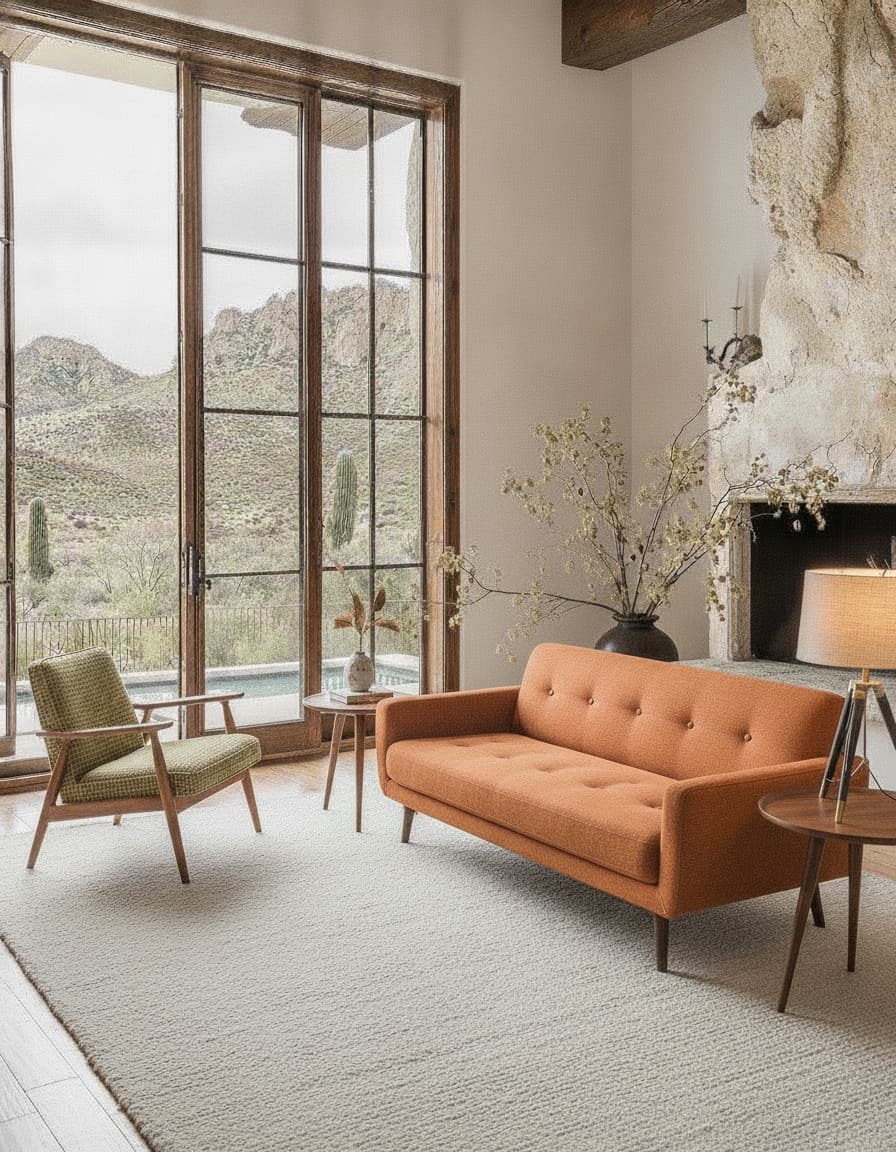
Colour plays its part too. A sofa close in colour to the walls and floor blends in; a strong colour, like the orange sofa in the picture above, makes it the room's centrepiece. For small spaces, small living room ideas has more.
How to test a sofa size at home
- Tape its outline on the floor with masking tape, at its full width and depth.
- Stack boxes to the height of its back to see how much of the wall and window it will hide.
- Walk the routes around it, open the doors, and sit where the coffee table will go.
- Live with it for a day or two, then decide.
To see the sofa itself rather than tape, you can also picture it in a photo of the room. In Calm Studio, Furnish can add a sofa you are considering, from its product photo, to a photo of your own room. It shows the look, not an exact measurement, so keep the tape on the floor until you are sure. How to see furniture in your room before buying explains the other ways to do this.
How the sofa sets the size of everything else
Once the sofa is chosen, many other sizes follow from it. The coffee table is about two-thirds of its length. Art above it is about two-thirds of its width. The rug runs 15 to 20 cm past each end, as the rug size guide explains. Getting the sofa right makes the rest of the room easy to plan, which is why how to arrange living room furniture starts from it.
Common sofa size mistakes
- Choosing in a large showroom, where every sofa looks smaller than it will at home.
- Measuring the room but not the doors, stairs and lift.
- A sofa so deep that most people sit on its front edge.
- A sofa that fills the whole wall, leaving no room for a lamp or a side table.
- Buying a corner sofa for a room where its corner blocks the way in.
Frequently asked questions
What size sofa suits a small living room?
A two-seater of 140 to 180 cm, or a compact three-seater of about 180 to 200 cm with slim arms, on legs. One well-sized sofa looks calmer than a sofa squeezed in beside an extra chair.
How long should a sofa be to lie down on?
Measure the inside length, between the arms, and choose one at least as long as you are tall. Low or armless ends make a shorter sofa more comfortable to lie on.
Should two sofas in one room be the same size?
Facing sofas look best at the same or a similar length. In an L-shaped layout, the second sofa can be shorter, or replaced by two armchairs.
Is a deeper sofa always more comfortable?
No. A deep seat is comfortable for lounging and for tall people, but shorter people end up perched on the edge or propped up with cushions. Try it sitting right back before you buy.