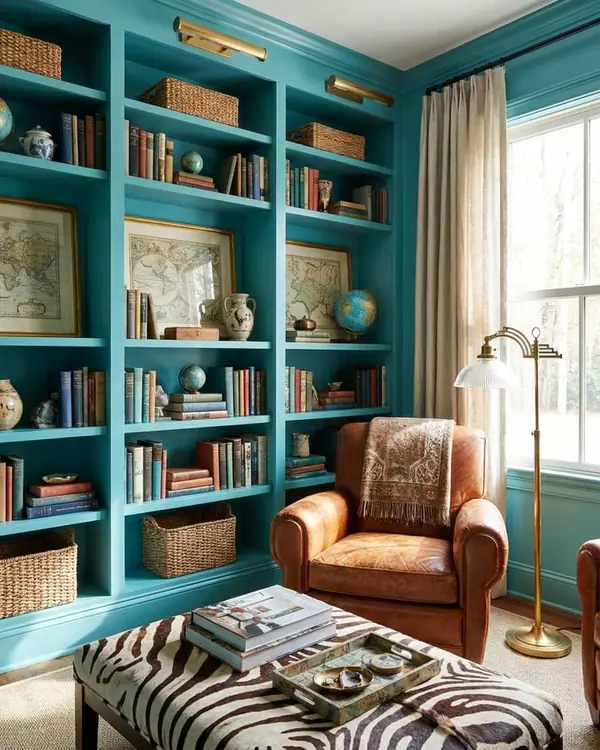
How to mix old and new furniture so it looks intentional
Quick answer
Let one era lead and the other accent it, roughly 80% to 20%, then connect them with a common thread: a shared colour, wood tone, material or shape, repeated at least twice. Spread the old pieces around the room instead of grouping them, pair opposites on purpose, such as a modern sofa with an antique chest, and keep the colour palette steady.

By Eduardo, founder of Calm Decoration
The rooms people remember are rarely bought in one go. A grandmother's chest beside a new sofa, a flea-market mirror over a modern console: the mix gives a room depth and a sense of history. This guide explains how to combine old and new so the result looks collected and deliberate, not like furniture waiting to go to the tip.
Why mix old and new furniture?
A room of only new pieces can look like a showroom, and a room of only antiques can feel like a museum. Mixing them gives you the comfort and practicality of new furniture with the character, craftsmanship and patina of old pieces.
It is also often the best value. Solid wood tables, chests and sideboards are widely available second-hand, and they were often built to last.
Antique, vintage, retro: what is the difference?
The words are used loosely, but dealers broadly mean this:
| Word | Usually means |
|---|---|
| Antique | About 100 years old or more |
| Vintage | Old enough to belong to an earlier era, often at least 20 years old |
| Retro | New or old pieces in the style of a recent past era, often the 1950s to 1980s |
| Contemporary | Made and designed now |
For decorating, the labels matter less than the effect: something with age and character beside something clean and current.
What is the 80/20 rule?
The 80/20 rule is a designer's rule of thumb for mixing: about 80% of the room in one style or era, and about 20% in another. One side clearly leads, so the room feels settled; the other adds contrast and personality.
You can turn it either way. A modern room with a few antiques (a carved chair, a gilt mirror, an old rug) feels fresh and characterful. A room full of old furniture with a few modern pieces (abstract art, a sculptural lamp, a simple linen sofa) feels lighter and less formal. A 70/30 split works too; a 50/50 split is the hardest to pull off, because nothing leads.
Find a common thread
Old and new pieces look as if they belong together when they share something. Pick one or two threads and repeat them.
| Thread | Example |
|---|---|
| Colour | A palette of cream, black and walnut across an antique dresser and a modern sofa |
| Material | Brass on a vintage lamp and on new cabinet handles |
| Shape | Curves in a 1930s mirror echoed by a new rounded sofa |
| Wood tone | A dark antique table with dark-framed modern chairs |
| Texture | Linen on a new sofa and on the seat of an old chair |
Keep the overall palette steady. When colours are under control, a mix of eras looks rich rather than chaotic; how to choose a colour palette shows how to set one.
How do you mix different wood tones?
Choose one wood tone to lead, then add one or two others that share its undertone or contrast clearly with it. Woods with a warm, red or orange lean (cherry, mahogany, pine) sit well together; woods with a cooler, greyer lean (whitewashed oak, ash, weathered timber) sit well together.
- Repeat each wood at least twice in the room, so none looks like a stray.
- Contrast clearly if you contrast: very light with very dark looks intentional; two almost-matching tones look like a mistake.
- Separate them with a rug, a painted piece or upholstery, so two woods do not touch directly.
- Count the floor. It is the largest wood surface in the room.
Pair opposites on purpose
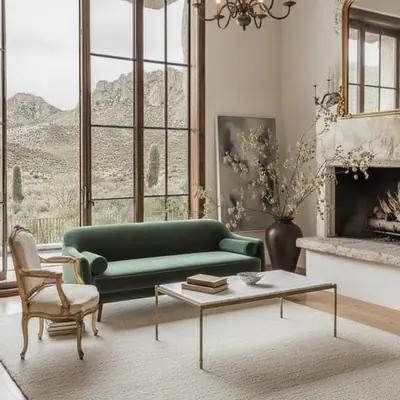
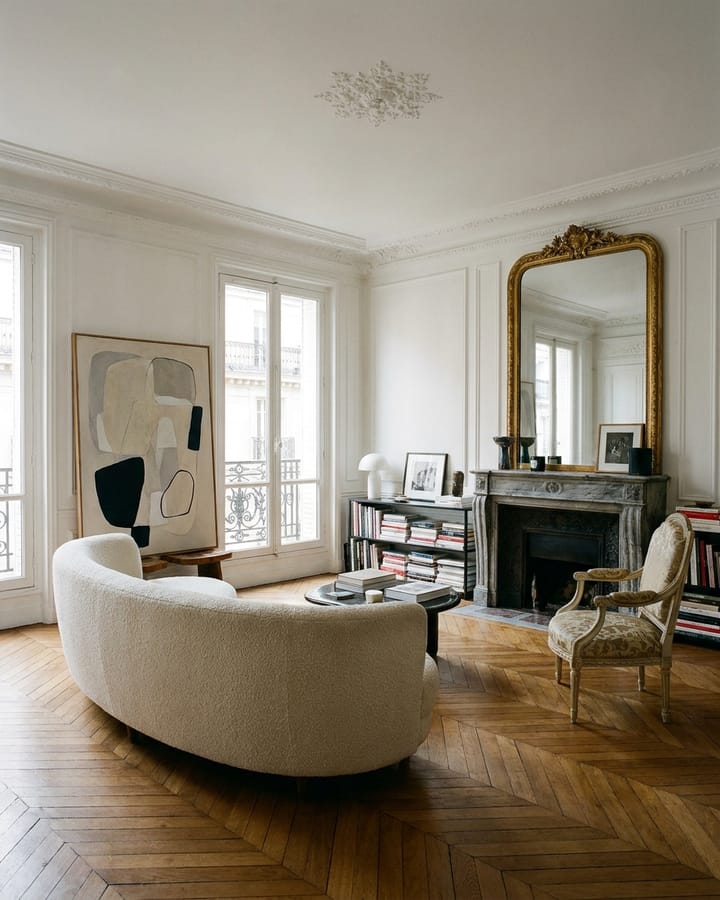
The most striking mixes put a clear opposite side by side, as in the Parisian room above, where a curved modern sofa and an abstract canvas sit beside an antique carved chair, a marble fireplace and a gilt mirror.
- A simple linen sofa with an antique chest as a coffee table.
- Modern chairs around an old farmhouse dining table.
- A glass or stone side table on a worn antique rug.
- Contemporary art in a plain frame above a carved sideboard.
- An old mirror above a sleek modern console.
The contrast works because each piece shows off the other. A carved chair looks more beautiful beside clean lines, and clean lines look warmer beside carving.
Where do old pieces work best?
Some furniture is usually better old, because it was built to last and gains character with age.
| Piece | Why old often works |
|---|---|
| Chests, sideboards and dressers | Solid wood and good joinery |
| Dining tables | Character, and often very sturdy |
| Mirrors | Frames with detail and a soft patina |
| Lamps | Interesting shapes and bases (have them checked or rewired) |
| Rugs | Worn patterns and natural dyes |
| Art and frames | One of a kind, often good value |
Other things are usually better new: a sofa you sit on every day (for comfort and support), a mattress, a desk chair, and anything that has to fit an exact space.
An old armchair or sofa with a good frame can be lovely, but expect to pay for new upholstery and filling.
How to check a second-hand piece before buying
- Push it gently. It should not rock or wobble; loose joints can be repaired, but factor in the cost.
- Open every drawer and door. They should run smoothly.
- Look for woodworm. Small round holes with fresh, fine dust nearby can mean the insects are still active.
- Smell it. Damp and smoke are hard to remove from wood and fabric.
- Check the upholstery for sagging springs and torn webbing. In some countries upholstered furniture must meet fire-safety rules, so look for a label.
- Measure it and the way into your home.
Should you paint or restore old furniture?
Paint a plain, worn pine or a mass-made piece freely: it can transform it. Think twice before painting or sanding a fine antique, because original finishes are part of its value; ask an expert if you think a piece may be valuable. Often a clean and a coat of wax is all an old piece needs.
Spread the old pieces around the room
Do not put all the old things in one corner and all the new ones in another. Spread them out, so the eye meets a mix wherever it looks: an old mirror on one wall, an antique chair across the room, a vintage rug in the middle. The same goes for a whole home: let a few old pieces appear in every room.
Step by step: mixing a room
- Decide which era leads, modern or old.
- Choose the palette and one or two common threads.
- Place the large pieces of the leading era first.
- Add two or three pieces of the other era, spread around the room.
- Repeat each wood, metal and colour at least twice.
- Finish with art and objects that mix eras too: an old frame with a new print, a modern vase on an old book.
If you are not sure which era should lead, it helps to know your style. How to find your interior design style walks you through it, and the Parisian, Eclectic, New traditional and Vintage styles all build on a mix of old and new.
Common mistakes
- A 50/50 split, where no era leads.
- Matching wood tones that do not quite match.
- Grouping all the old pieces together like a shop display.
- Too many statement pieces, each fighting for attention.
- Buying old just because it is old. Every piece should still suit the room's size, use and palette.
Frequently asked questions
Can I mix mid-century furniture with antiques?
Yes. Mid-century pieces have clean lines and warm woods that sit well beside older, more detailed furniture. Keep a shared palette and let one of the two lead.
Can I mix metals in one room?
Yes, two metals usually look good: for example brass for warmth and black iron for definition. Repeat each one at least twice so the mix looks planned.
Does my furniture need to match my wooden floor?
No. It usually looks better if it does not match exactly. Choose furniture that is clearly lighter or darker than the floor, or put a rug in between.
How many vintage pieces does a modern room need?
Even one or two make a difference. A single antique mirror or an old wooden chest gives a modern room a sense of history.