How to style shelves and coffee tables, step by step
Quick answer
Work from big to small. On shelves, place the books first, some standing and some stacked, then a few larger objects, then small ones, and leave roughly a quarter to a third of each shelf empty. On a coffee table, use a tray, a stack of books and one living or sculptural thing, grouped in odd numbers at different heights, with space left for cups.

By Eduardo, founder of Calm Decoration
Styled shelves and coffee tables are what make a room look finished, and they are the easiest thing to change on a Sunday afternoon with what you already own. This guide gives you the principles designers use, then the exact steps for a bookshelf, a coffee table, a console and a mantel.
The principles behind every well-styled surface
Every good arrangement uses the same few ideas. Once you know them, you can style any surface.
- Odd numbers. Groups of three or five look more natural than pairs, which feel formal and static.
- Different heights. Put something tall, something medium and something low in each group, so the eye moves up and down.
- Triangles. Arrange each group so the tops of the objects form a rough triangle.
- Contrast of materials. Mix smooth and rough, shiny and matt: a glazed vase beside a wooden bowl and a stack of linen-bound books.
- Repetition. Repeat a colour or material in two or three places so the whole thing feels connected.
- Empty space. The space around objects is what lets you see them. A full surface reads as clutter.
- Useful and beautiful. The best arrangements include things you use: a book you are reading, a bowl for keys, a tray for the remote.
How to style a bookshelf, step by step
- Empty it completely and clean it. It is far easier to start fresh than to rearrange.
- Choose what goes back. Pick books and objects in a palette that suits the room; two or three colours plus wood, white and black are plenty.
- Place the books first. Alternate rows of standing books with horizontal stacks of three to six. Leave some shelves with only a few books.
- Add the anchors. Put the largest things in next: baskets or boxes on the lower shelves, a large vase, a piece of art leaning against the back.
- Add the middle-sized objects: a ceramic, a lamp, a plant, a framed photo, often sitting on top of a horizontal stack of books.
- Add a few small things last, grouped rather than dotted around.
- Zigzag. Place similar things (a colour, a material, a plant) in a loose zigzag down the shelves, so the eye travels across the whole unit.
- Step back and edit. Look from across the room, squint, and remove anything that does not earn its place.
How many things should go on a shelf?
Leave roughly a quarter to a third of each shelf empty as a rule of thumb. If a shelf has to hold more, make it books, which look orderly in a row, rather than small objects.
Fewer, larger pieces look calmer than many small ones. A shelf with one generous vase and a stack of books looks more confident than one with seven little things.
What can you put on shelves?
| Kind | Examples |
|---|---|
| Books | Standing in rows, stacked flat, a few with their covers showing |
| Storage | Woven baskets, lidded boxes, magazine files |
| Ceramics and glass | Vases, bowls, jugs, candlesticks |
| Art | Small framed prints and photos leaning at the back, overlapping |
| Living things | Trailing plants on high shelves, a branch in a vase |
| Natural finds | Stones, shells, a piece of driftwood, a pine cone |
| Personal things | A few photos, a souvenir, something handmade |
Should books face spine out, by colour or stacked?
Spine out is the practical choice, and it is how books should mostly sit: you can find them and they look like a library. Mixing standing rows with flat stacks adds rhythm, and a stack is a ready-made stand for a small object.
Arranging books by colour can look striking on one open unit, but it makes finding a title harder. Turning spines to the wall hides the titles completely; I would not do it to books you read.
How to style a coffee table
- Clear it, then think about how you use it: cups, feet, games, a laptop.
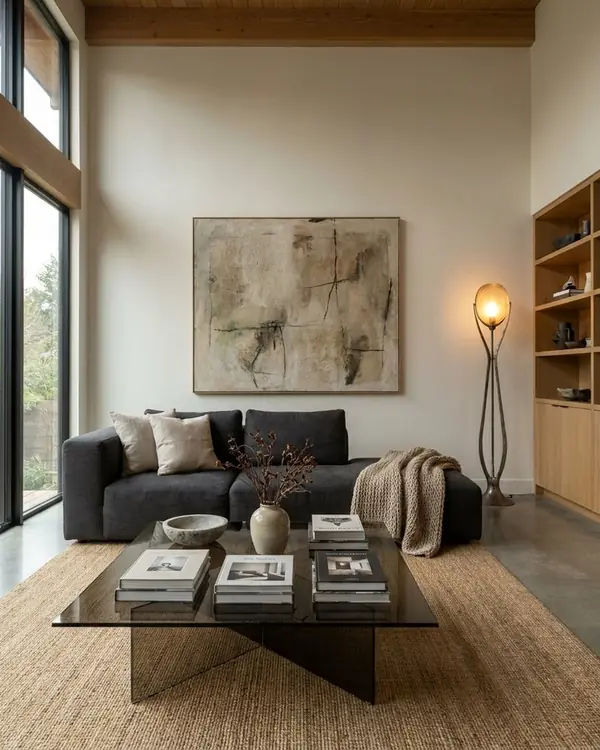
- Add a tray to gather the small things so they look intentional and can be lifted off in one go.
- Add a stack of two to four books, large ones at the bottom.
- Add one living thing: flowers, a branch in a vase or a small plant.
- Add one sculptural or personal object on top of the books or beside them: a bowl, a candle, a ceramic piece.
- Keep it low enough to see across. Flowers should not block the view between the sofa and the chairs.
- Leave at least half of it clear for real life.
On a rectangular table, make one main group off-centre, or two smaller groups towards each end. On a round table, gather everything in the middle. On an upholstered ottoman, always use a tray, so a glass has somewhere stable to stand. The coffee table size guide covers choosing the table itself.
| Element | Why it is there | Examples |
|---|---|---|
| A tray | Gathers and contains | Wood, rattan, stone, leather |
| Books | Height and colour | Large art, travel or design books |
| Something living | Freshness and softness | Flowers, a branch, a small plant |
| Something sculptural | Character | A bowl, a ceramic, a candle |
Consoles, sideboards and mantels
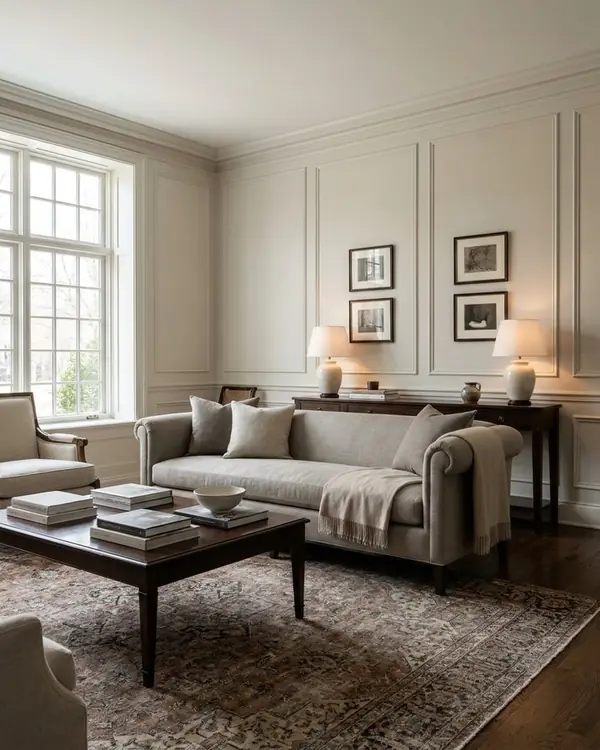
These surfaces sit against a wall, so the arrangement includes what hangs or leans above them. Start with the biggest piece: a lamp or a large piece of art, then build around it.
- Symmetric: a pair of lamps at each end with art centred between them. Calm and formal, good in a hallway or behind a sofa.
- Asymmetric: a lamp at one end, art leaning off-centre and a group of three objects at the other end. Relaxed and more personal.
- Layered art: lean a large piece at the back and a smaller one overlapping it in front. Nothing needs hanging, and you can change it easily.
Keep the art and the console in proportion: art roughly two-thirds the width of the furniture below it usually looks right. If you do hang it, how high to hang art gives the heights.
Open kitchen shelves
Kitchen shelves work best when they are mostly useful: the plates, glasses and bowls you use every day, a few jars of what you cook with, a wooden board leaning at the back. Keep to two or three colours and stack in groups of the same thing. They look tidy because they are used and put back.
Common mistakes
- Too many small objects spread evenly over every shelf.
- Everything the same height, so the arrangement looks flat.
- All the colour on one shelf instead of spread across the unit.
- A coffee table too full to use.
- Only new things. A shelf with one old book, a found stone and a vintage bowl has more character than one bought in a single shop. Mixing old and new explains why.
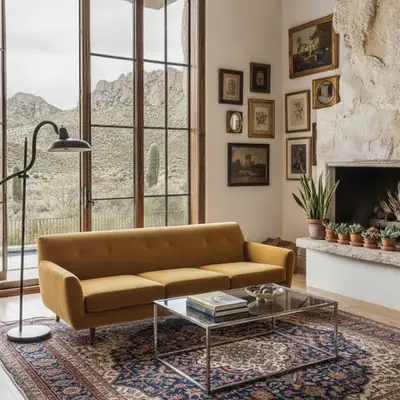
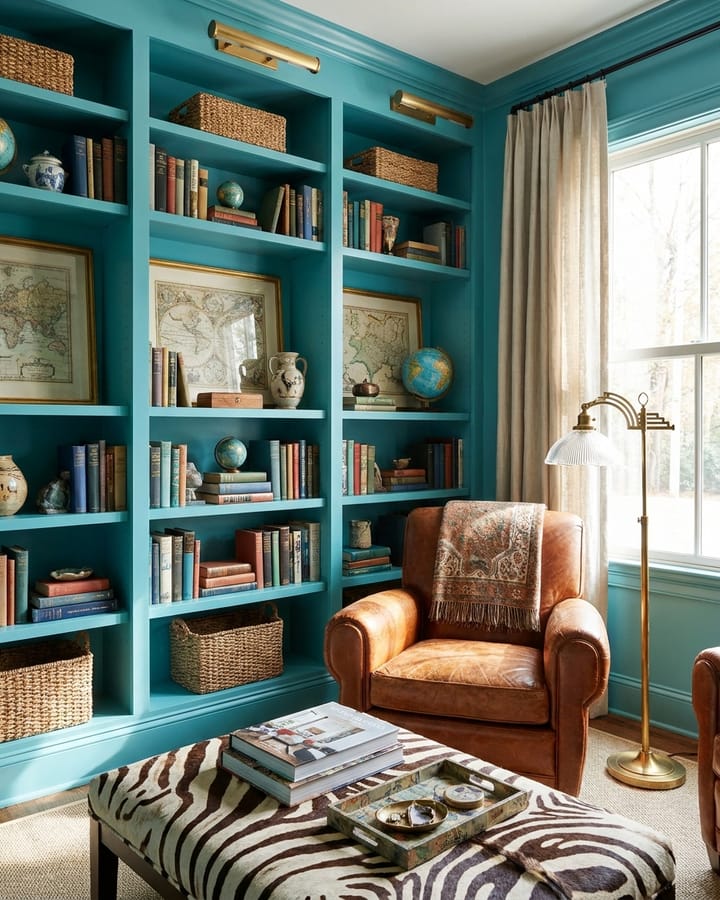
Shelves full of books, maps, baskets and finds from different places, as in the room above, are typical of the Eclectic style. Keep the palette steady, using the ideas in how to choose a colour palette, and the mix still looks calm.
Frequently asked questions
What if I have far too many books to leave space on the shelves?
Let the books fill most of the shelves in neat rows and style only a few at eye level with objects. A wall of books is beautiful in its own right.
How do I style shelves on a budget?
Shop your own home first: books, bowls, jugs, baskets and plants from other rooms usually give you enough. Add natural things like branches and stones, which cost nothing.
How do I style a shelf above a television?
Keep it simple and low, with a few books and one or two larger objects. Too much detail above a screen competes with it and looks busy.
How often should I restyle shelves?
Whenever they start to feel stale, often with the seasons. Swapping a few objects and the flowers is usually enough.