How high to hang art, and how to plan a gallery wall
Quick answer
Hang art with its centre about 145 to 152 cm (57 to 60 in) from the floor, roughly at eye level. Above a sofa, bed or sideboard, leave 15 to 25 cm (6 to 10 in) between the furniture and the bottom of the frame, and choose art about two-thirds as wide as the piece below. Space a gallery wall's frames 5 to 8 cm apart.

By Eduardo, founder of Calm Decoration
This guide is for anyone holding a picture against a wall and wondering where the nail should go. It gives the height that works in almost every room, the rules for art above furniture, how big a piece should be, and a step-by-step method for a gallery wall that looks planned rather than scattered.
How high should you hang a picture?
Hang a picture so that its centre is about 145 to 152 cm (57 to 60 in) from the floor. That is roughly the eye level of an adult standing, and it is the height many galleries and museums use, so it works whatever the size of the frame.
The most common mistake is hanging art too high, close to the ceiling or level with the top of a door. Art up there floats away from the room and the people in it. Hung at eye level, it becomes part of the furniture group below it.
Treat a group of pictures, a pair or a triptych as one piece: its centre, not each frame's, goes at 145 to 152 cm.
How to work out where the nail goes
The centre of the frame is not where the hook goes, because the wire or hanger sits lower than the top of the frame. Use this simple sum:
Nail height = 145 cm + half the frame's height − the distance from the top of the frame to the taut wire.
For a frame 60 cm tall whose wire, pulled tight, comes to 8 cm below the top: 145 + 30 − 8 = 167 cm from the floor.
- Measure the frame's height and halve it.
- Pull the wire or cord up tight with a finger and measure from that point to the top of the frame.
- Add half the height to 145 cm, then take away the wire measurement.
- Mark the spot lightly in pencil, check it with a spirit level and fix the hook.
- For wide or heavy frames, use two hooks set apart, so the picture stays level.
How high to hang art above a sofa
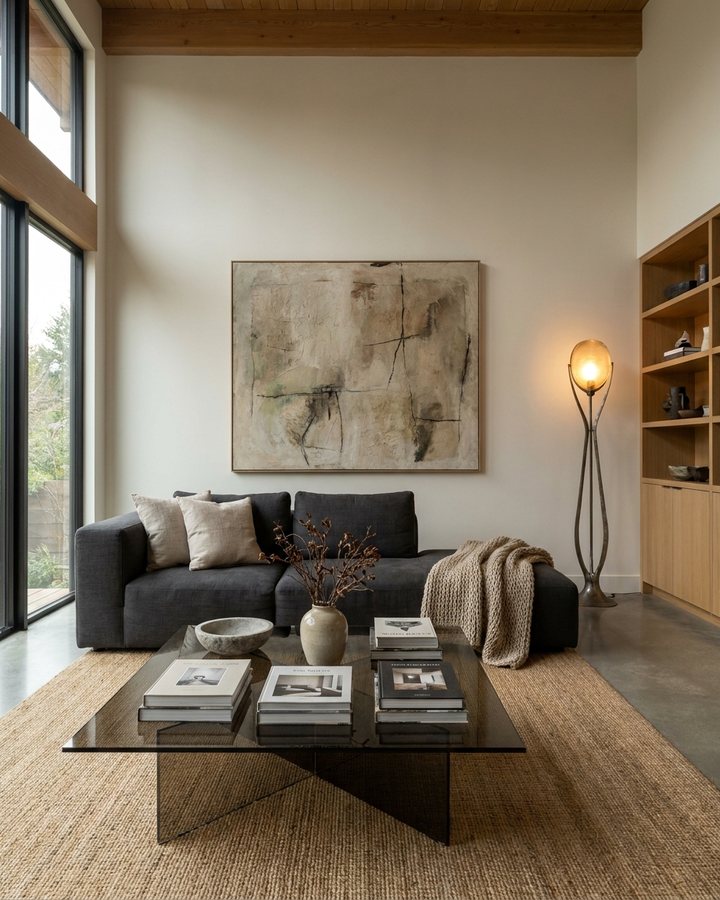
Above a sofa, leave 15 to 25 cm (6 to 10 in) between the top of the sofa's back and the bottom of the frame. Closer and heads will knock it; higher and the art drifts away from the sofa, so the two no longer look like one composition.
Here the gap to the furniture matters more than the 145 cm centre. With a low sofa, the art may sit a little lower than eye level, and that is right: the eye reads the sofa and the art together.
The art, or the group of frames, should be about two-thirds the width of the sofa: about 140 to 150 cm wide over a 220 cm sofa. Never let it be wider than the sofa itself. For a long sofa, a landscape piece, a pair side by side or a row of three fills the width better than a single tall portrait.
Above a bed, a sideboard or a fireplace
The same idea applies to every piece of furniture: the art belongs to the furniture beneath it.
| Above | Gap to the bottom of the frame | Width of the art or group |
|---|---|---|
| Sofa | 15 to 25 cm (6 to 10 in) above the back | About two-thirds of the sofa |
| Bed | 15 to 25 cm above the headboard | About two-thirds of the bed's width |
| Sideboard or console | 15 to 25 cm above the top | Two-thirds to three-quarters of its length |
| Fireplace | 15 to 25 cm above the mantelpiece | No wider than the mantelpiece |
Above a bed, choose light frames with acrylic rather than glass, and fix them securely: nobody wants a heavy frame over their head. More on the wall behind the bed is in the bedroom layout guide.
On a sideboard or mantelpiece you can also lean art instead of hanging it, and layer a smaller frame in front of a larger one. Leaning, relaxed art is part of the Parisian look.
How big should art be?
Most art in homes is too small for its wall. A small frame alone on a large wall looks lost, while one generous piece calms a wall more than several small ones scattered across it.
Use the furniture below as your guide, two-thirds of its width, and when the wall is bare, go larger than feels natural.
| Furniture below | Its typical width | Art or group about |
|---|---|---|
| Two-seat sofa | 160 cm | 105 cm |
| Three-seat sofa | 220 cm | 145 cm |
| Large sofa | 260 cm | 170 cm |
| Double or king bed with headboard | 160 cm | 105 cm |
| Sideboard | 180 cm | 120 to 135 cm |
If one large piece is beyond your budget, a pair or a set of three identical frames, hung close together, reads as one large piece.
How to plan a gallery wall
A gallery wall works when it looks like one picture made of many. Plan it on the floor and on paper before a single nail goes in.
- Choose a common thread: the same frame colour, the same mount, a shared palette or a theme. Without one, the wall looks random.
- Pick an anchor, usually the largest piece, and place it near the centre of the group, slightly off-centre if you like a relaxed look.
- Lay everything out on the floor in front of the wall, move it until the outer edge forms a loose rectangle, and take a photo.
- Cut a paper template for each frame, mark where its hook falls, and tape the templates to the wall. Live with them for a day.
- Keep the gaps even, about 5 to 8 cm (2 to 3 in) between frames. Even gaps are what make mixed frames look like a set.
- Place the group by the usual rules: its centre at 145 to 152 cm on a bare wall, or its bottom edge 15 to 25 cm above the furniture.
- Hang from the anchor outwards, nailing through the paper templates, then tear them off.
There are three classic arrangements:
- Grid: identical frames in rows and columns with equal gaps. Calm and formal, and the easiest to get right.
- Salon: mixed sizes and shapes, with an outer edge that roughly forms a rectangle. Lively, and at home in Eclectic or maximalist rooms.
- On a line: frames of different sizes whose centres, top edges or bottom edges line up along one invisible line. A good middle way.
Stairs, hallways and dining rooms
On a staircase, follow the slope of the stairs. Measure 145 to 152 cm up from the step directly below the centre of each frame, so every picture sits at eye level for someone climbing. In a narrow hallway, choose slim frames that nobody will brush past.
In a dining room, where people look at the art sitting down, it can sit a little lower than in a hallway, as long as it still relates to the table or sideboard.
Mirrors
A mirror follows the same rules as art, with one addition: think about what it reflects. A mirror beside or across from a window bounces daylight into the room; one facing a cluttered corner doubles the clutter. Above a console in an entrance, hang it so an adult can see their face without stretching.
Hanging it securely
Use picture hooks rated for the weight of the frame, and two hooks for anything wide or heavy. On plasterboard, use fixings made for plasterboard, or screw into a timber stud; on brick or block, use a wall plug and screw. Small felt pads on the lower corners keep frames from tilting and marking the wall. If you rent, see decorating a rented home for ways to hang art with fewer holes.
Frequently asked questions
Should art be centred on the wall or on the furniture?
On the furniture below it. If a sofa is off to one side of a wall, centre the art on the sofa, not on the wall, so the two read as one.
How far apart should two pictures hang?
About 5 to 8 cm (2 to 3 in), with their tops and bottoms lined up when the frames are the same size. Further apart, they stop reading as a pair.
Do high ceilings mean I should hang art higher?
No. Art relates to people and furniture, not to the ceiling, so keep the centre at 145 to 152 cm. To fill a tall wall, choose a taller piece or stack two frames vertically.
Can I lean art instead of hanging it?
Yes, on a mantelpiece, a sideboard or a picture ledge, and a very large piece can lean against the wall on the floor. Make sure anything large is secured so it cannot slide or tip.