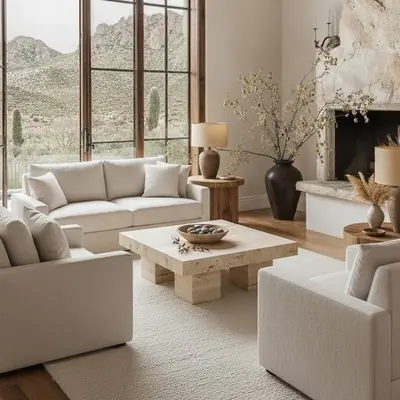
Interior design basics: the rules designers use
Quick answer
The basics of interior design are a handful of rules of thumb: give each room one focal point, keep furniture in scale with the room, balance visual weight, follow the 60-30-10 colour rule, mix at least three textures, light in three layers, keep walkways about 90 cm (36 in) wide, and size rugs, curtains and art generously. Together they make a room feel calm and finished.

By Eduardo, founder of Calm Decoration
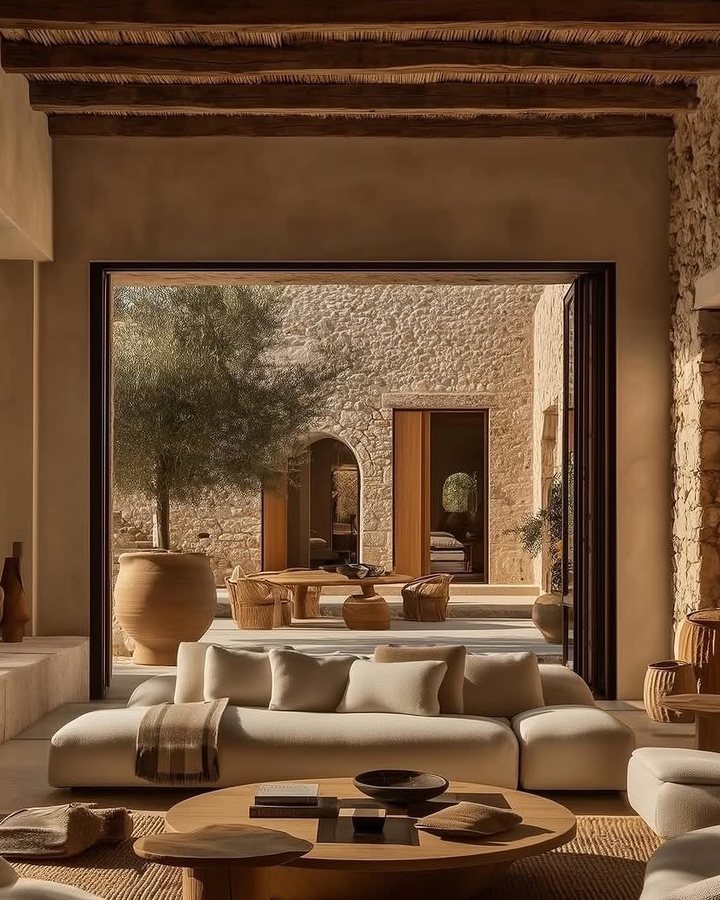
This guide is for anyone who has never studied interior design and wants to know why some rooms feel right and others do not. It sets out the twelve rules of thumb I find myself using in every room, what each one means in practice, and the handful of measurements worth knowing by heart.
What are the basic rules of interior design?
Interior design rests on a small number of principles: function, a focal point, scale, balance, colour, texture, repetition, light, space to move, generous sizes, grouping and restraint. None of them needs talent, only attention, and a room that follows most of them nearly always looks good.
| Rule | In one line |
|---|---|
| 1. Function first | The room is planned around what happens in it |
| 2. One focal point | One thing the eye goes to first, and the seats face it |
| 3. Scale and the two-thirds rule | Pieces sized to the room and to each other |
| 4. Balance | Visual weight spread across the room |
| 5. The 60-30-10 rule | A main colour, a second colour and an accent |
| 6. Three textures or more | Smooth, rough and soft, so a calm palette never looks flat |
| 7. Say it three times | Each colour and material repeated around the room |
| 8. Three layers of light | General light, light to read or cook by, and accents |
| 9. Room to move | Walkways about 90 cm (36 in) wide |
| 10. Go bigger | Rugs, curtains and art larger than you first think |
| 11. Odd numbers, different heights | Groups of three or five look natural |
| 12. One star, and some empty space | A single statement piece, and room to breathe |
Rule 1: Function first
A room is designed around what happens in it, before what it looks like. A living room where the family watches films needs a different sofa, light and layout from one used for conversation and reading. List the activities first, then let the furniture follow; a beautiful room that is awkward to use will not stay beautiful for long.
Rule 2: Give every room one focal point
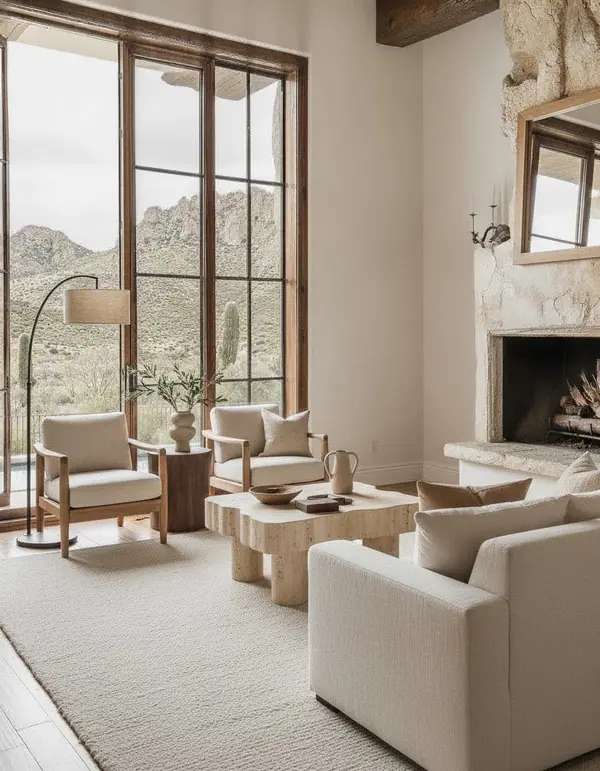
Every room needs one thing the eye goes to first: a fireplace, a view, a large artwork, a bed with a striking headboard. Arrange the main furniture to face it or frame it. A room with no focal point feels aimless, and a room with three competing ones feels restless. If a TV must share a wall with the fireplace, treat them as one composition.
Rule 3: Scale and proportion, and the two-thirds rule
Scale is how big a piece is compared with the room; proportion is how pieces relate to each other. Large rooms need generous pieces, small rooms fewer pieces, not smaller ones. Designers return again and again to a simple ratio, two-thirds:
- A coffee table about two-thirds the length of the sofa in front of it.
- Art about two-thirds the width of the furniture beneath it.
- A sofa about two-thirds the length of the wall it stands against.
Rule 4: Balance
Balance is the sense that no side of the room is heavier than another. Symmetrical balance, a pair of lamps either side of a sofa or two chairs facing each other, feels formal and restful. Asymmetrical balance, a tall plant on one side weighed against a heavy armchair on the other, feels relaxed. Dark colours, solid bases and large patterns carry more visual weight than pale colours, legs and plain fabric.
Rule 5: The 60-30-10 colour rule
Use a main colour on about 60% of the room, usually the walls and large surfaces, a second colour on about 30%, such as the sofa, curtains and rug, and an accent on the last 10%, in cushions, art and objects. It is a rule of thumb, not maths, but it stops a room from being either flat or chaotic. How to choose a colour palette for a room shows how to pick the three.
Rule 6: Mix at least three textures
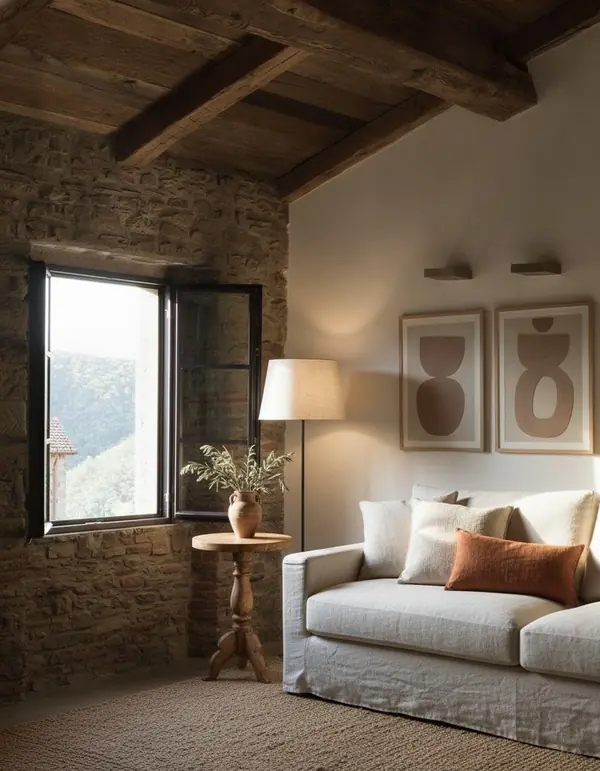
A room in one colour still looks rich when its textures differ. Put something smooth (glazed ceramic, polished wood, marble) beside something rough (linen, jute, stone) and something soft (wool, bouclé, velvet). Texture is what makes the quiet rooms of Calm and other natural styles feel warm rather than bare.
Rule 7: Say it three times
Repeat each colour and material at least three times around the room: the rust of a cushion again in a vase and in a print, the oak of the table again in a frame and a stool. Repetition creates rhythm, and it is what makes a room look chosen rather than assembled. A colour that appears only once looks like a mistake.
Rule 8: Light in three layers
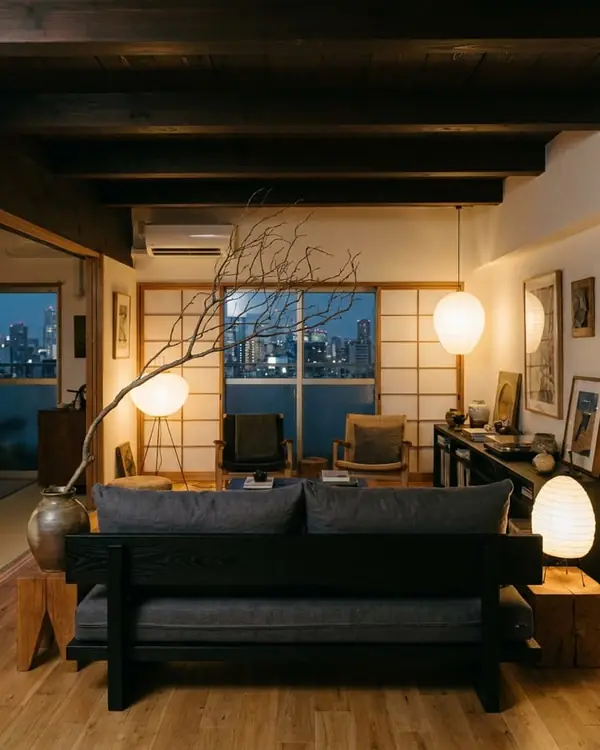
Every room needs three kinds of light: general light to see by, task light to read, cook or work by, and accent light for art, plants and texture. Several lamps at different heights make a room far warmer than one bright ceiling light. For living rooms and bedrooms, warm white bulbs of about 2,700 K feel right. How to light a room covers each layer.
Rule 9: Leave room to move
A room must be easy to walk through. Keep main walkways about 90 cm (36 in) wide and never less than about 60 cm (24 in) between pieces, keep door swings clear, and leave 40 to 45 cm between a sofa and its coffee table. Crowded rooms feel smaller and more stressful than they are.
Rule 10: Go bigger with rugs, curtains and art
The three most common sizing mistakes are a rug too small, curtains hung too low and art too small or too high. As a rule:
- The rug holds at least the front legs of every seat: see the rug size guide.
- Curtains hang close to the ceiling and wider than the window: see the curtain height guide.
- Art is hung with its centre at about 145 to 152 cm (57 to 60 in) from the floor: see how high to hang art.
Rule 11: Group in odd numbers, at different heights
When you style a shelf, a table or a mantelpiece, groups of three or five objects look natural, and even numbers look staged. Vary their heights, a tall vase, a medium bowl, a low stack of books, so the eye moves across them. The same works for plants in a corner and frames on a wall.
Rule 12: One statement piece, and some empty space
Give each room one star, such as a sculptural light, a bold chair or a large painting, and let the rest support it. Then leave some surfaces and some wall bare. Empty space is not unfinished; it is what lets the eye rest and the chosen pieces stand out.
The measurements worth knowing
| What | Rule of thumb |
|---|---|
| Main walkway | About 90 cm (36 in) |
| Sofa to coffee table | 40 to 45 cm (16 to 18 in) |
| Centre of a picture | 145 to 152 cm (57 to 60 in) from the floor |
| Art above a sofa | 15 to 25 cm (6 to 10 in) above its back |
| Curtain pole | At least 15 cm above the frame, ideally near the ceiling |
| Rug to the walls | 20 to 45 cm (8 to 18 in) of floor showing |
| Behind dining chairs | At least 90 cm (36 in) to a wall |
| Pendant over a dining table | 75 to 90 cm (30 to 35 in) above the top |
| Bedside table | Level with the top of the mattress |
When to break the rules
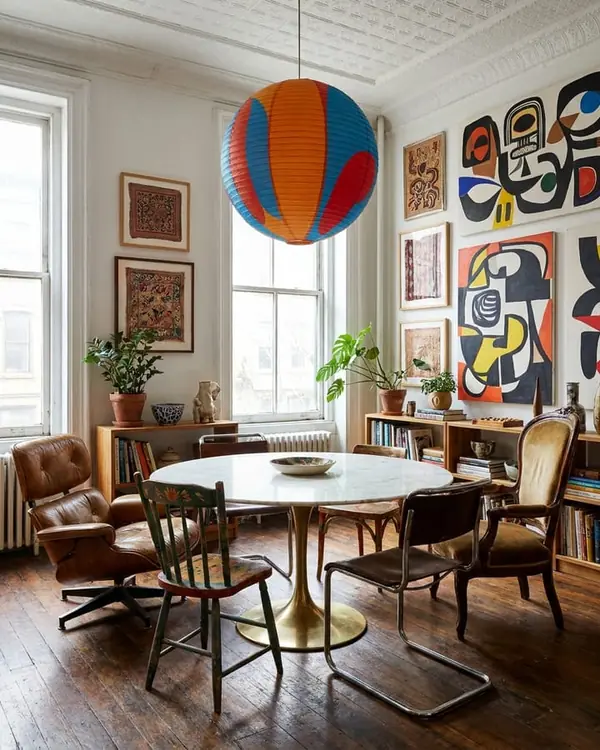
Once you know why a rule exists, you can break it on purpose. A tiny room painted dark from floor to ceiling breaks the "light colours make rooms bigger" idea and becomes cosy instead. A maximalist room breaks restraint and works because everything in it is chosen with confidence. The rules are a safety net, not a cage.
If you want to see which rules your own room follows, the Room audit in Calm Studio reads a photo of it and marks a designer's advice on the spots that matter.
Frequently asked questions
What is the most important rule in interior design?
If I had to choose one, it would be scale. A room with the right-sized rug, sofa and art looks good even with simple pieces; the most beautiful pieces at the wrong size never do.
What are the seven elements of interior design?
They are usually listed as space, line, form, light, colour, texture and pattern. The rules above are ways of handling those elements well.
Do I need to follow every rule?
No. Follow most of them most of the time, and break one deliberately when you know what you gain. A room that follows none of them usually feels uncomfortable without anyone being able to say why.
How do I make a room look finished?
Check the layers: a rug of the right size, curtains, at least three lamps, art on the walls, something living such as a plant, and one or two personal objects. A room missing one of these usually looks unfinished.