How to make a moodboard for a room, step by step
Quick answer
An interior moodboard puts a room's colours, materials and main pieces on one page, so you can see them together before you buy. Start with what stays in the room, then add about five colours, five or six materials with where each will be used, and about four key pieces, such as the sofa, a chair, a table and a lamp. Edit out anything that does not belong.

By Eduardo, founder of Calm Decoration
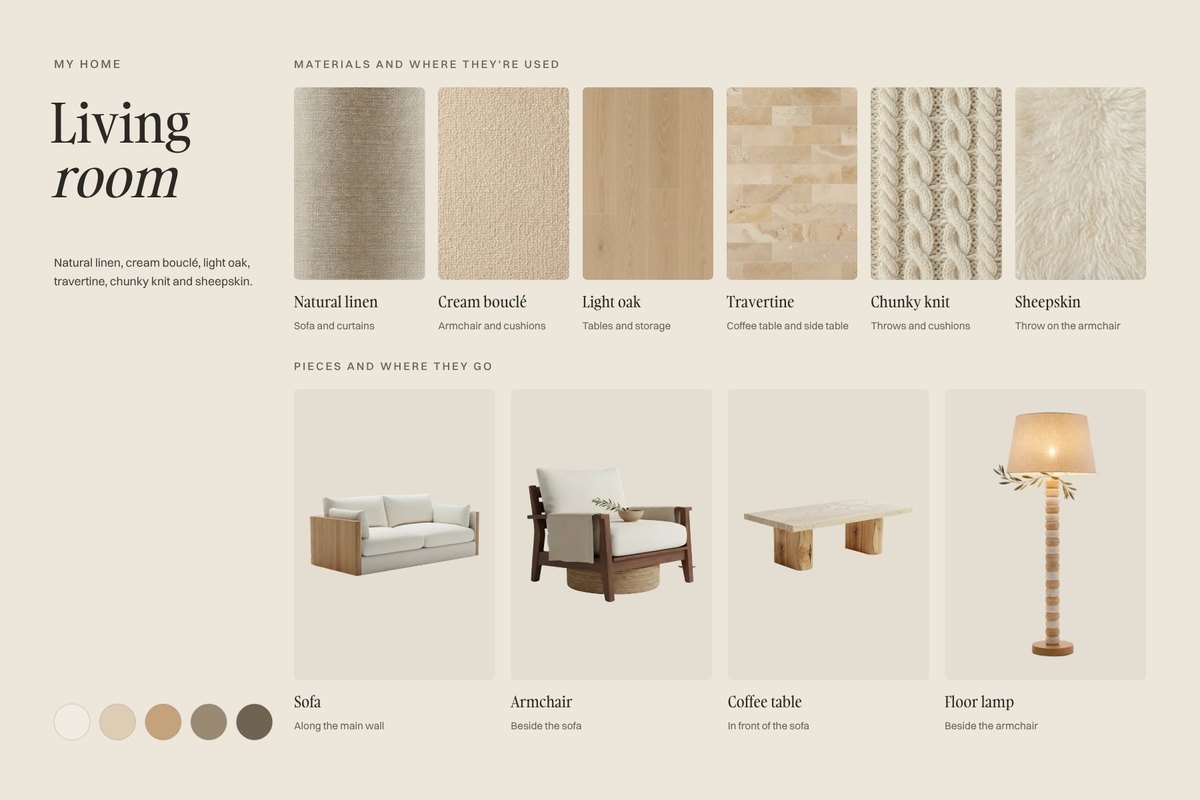
This guide is for anyone planning a room who has a phone full of saved pictures and no clear plan yet. It explains what a moodboard is for, what goes on one, how to make one step by step, and how to use it to shop and to check the room before you spend.
What is a moodboard in interior design?
A moodboard is a single page, on a wall or a screen, that holds a room's colours, materials and key pieces together, so you can judge them as a whole before anything is bought. Designers use one to agree a direction with a client; you can use one to agree it with yourself.
There are two kinds, and it helps to know the difference. An inspiration board collects pictures of other people's rooms to capture a mood. A design board turns that mood into decisions: the actual paint colours, fabrics, woods and furniture for this room. The first is a good place to start; the second is the one that changes what you buy.
What should go on a moodboard?
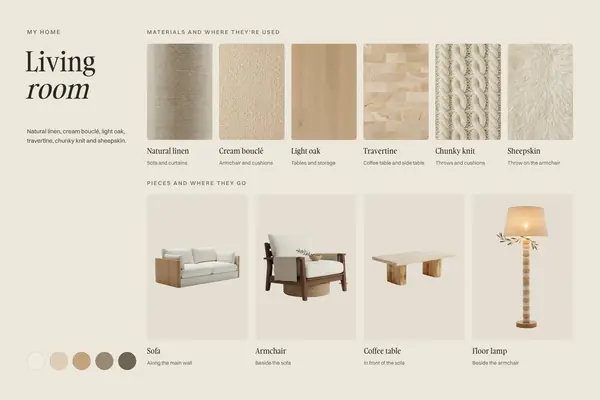
A useful design board holds a small number of decided things, not everything you like. This is the structure I use, and the one the board at the top of this page follows.
| What | How many | Why |
|---|---|---|
| What stays | Everything you keep | The floor, a fireplace or a sofa you keep must work with the rest |
| Colours | About five | A main colour, a second, an accent, and the tones of wood and metal |
| Materials | Five or six, each with where it is used | Texture makes a calm palette rich, and naming the place forces a decision |
| Key pieces | About four | The anchor pieces, such as the sofa, an armchair, a table and a lamp |
| Words | Three | How the room should feel, to check every choice against |
Inspiration photos of whole rooms can sit beside the board while you work, but take them off once the decisions are made: a photo of someone else's sofa on your board quietly becomes a sofa you did not choose.
How to make a moodboard, step by step
- Write three words for how the room should feel, such as calm, warm and uncluttered.
- Photograph the room in daylight and list what stays: the floor, the fireplace, any furniture you are keeping. Add a photo or sample of each to the board first.
- Choose the palette: about five colours, with the main one first. How to choose a colour palette for a room explains how to pick them.
- Gather the materials: fabric swatches, paint sample cards, a wood offcut, a tile. Next to each, write where it goes: "Linen: sofa and curtains", "Oak: tables and shelves".
- Add the key pieces, ideally as product photos on a plain background, so their shapes are easy to compare. Note each one's size and where it will stand.
- Edit. Take away anything that does not relate to the rest. Check that each colour and material appears more than once, that there is something smooth, something rough and something soft, and a balance of light and dark.
- Test it in the room. Hold the samples against the walls and floor in the morning, in the afternoon and under lamps at night. Colours change with the light, and a sample that looked right on the board can look different in place.
The example board, explained
The board at the top of this page is for a living room. Its six materials each have a place: natural linen for the sofa and curtains, cream bouclé for the armchair and cushions, light oak for the tables and storage, travertine for the coffee table and side table, chunky knit for throws and cushions, and sheepskin as a throw on the armchair. Its four pieces each have a spot: a sofa along the main wall, an armchair beside it, a coffee table in front of the sofa and a floor lamp beside the armchair. Five colours run from warm white through sand and caramel to a deep olive brown.
Nothing on it is there only because it is pretty; everything answers a question about the room. That is the difference between a design board and a collection of pictures. Its quiet palette of linen, travertine and light oak is close to Calm, Calm Decoration's own style.
What to put on a moodboard for other rooms
The structure stays the same in every room; only the key pieces and the materials to decide change.
| Room | Key pieces | Materials to decide |
|---|---|---|
| Bedroom | Bed and headboard, bedside tables, a reading lamp, the rug | Bedding, the headboard's fabric, curtains or blinds, the wood of the furniture |
| Dining room | Table, chairs, the light above the table, a sideboard | The table top, the chair seats, the rug, the metal of the light |
| Kitchen | Cabinet fronts, stools, the lights over the worktop | Worktop, splashback tile, handles and taps, the floor |
| Home office | Desk, chair, a desk lamp, storage | The desk top, shelving, a pinboard or acoustic panel, the rug |
In a kitchen, the worktop and the cabinet colour are the expensive, permanent decisions, so put real samples of both side by side before anything else.
Should you make a moodboard by hand or on screen?
Both work, and many designers combine them: a digital board for the furniture and the overall look, and real samples on a tray or a sheet of card for the colours and textures.
| By hand | On screen | |
|---|---|---|
| Colours | True, in your own light | Vary from screen to screen |
| Textures | You can touch them | Only suggested |
| Furniture | Cut-outs from catalogues | Easy to add and swap |
| Changing it | Slow | Quick |
| Sharing it | A photo of the board | Easy to send |
Whichever you choose, keep the board where you will see it often. Decisions get better when you live with them for a few days.
Common moodboard mistakes
- Only inspiration, no decisions: lovely rooms, but no paint colour, fabric or sofa chosen.
- Too much on it: twenty colours and forty products tell you nothing.
- Forgetting what stays: a board built around a pale floor when yours is dark oak.
- Tiny samples of big patterns: a bold print on a whole sofa looks very different from a 5 cm square.
- Trusting the screen: always check paint and fabric colours with real samples.
If you have not settled on a style yet, do that first: how to find your interior design style shows how, and the free style quiz helps.
From moodboard to a finished room
A finished board becomes two things. The first is a shopping list in the right order, anchor pieces first and accessories last. The second is a picture of the room you can check before you spend, which is the hardest part to imagine from a board alone.
In Calm Studio, the Moodboard is laid out like a designer's board, with five colours, six materials and four pieces, each with a line for where it goes, and "See it in my room" then restyles a photo of your own room with the board's pieces. How to see furniture in your room before buying explains this and other ways to preview. The last lesson of the course, bring it together, takes you from the board to the shopping order.
Frequently asked questions
How many items should a moodboard have?
Fewer than you think: about fifteen, such as five colours, six materials and four pieces. If the board needs explaining, it holds too much.
Do I need a separate moodboard for each room?
Yes, one per room, but keep a thread between them, such as a shared colour, wood or metal, so the home feels connected as you move through it.
Can I make a moodboard without buying samples?
Yes. Paint cards and many fabric swatches are free or cost little, and photos work for furniture. Before you paint a whole wall, though, test a large painted sample in the room itself.
How long does it take to make a moodboard?
An evening to gather and a few days to live with it. Waiting for samples to arrive is usually the slowest part, so order them first.