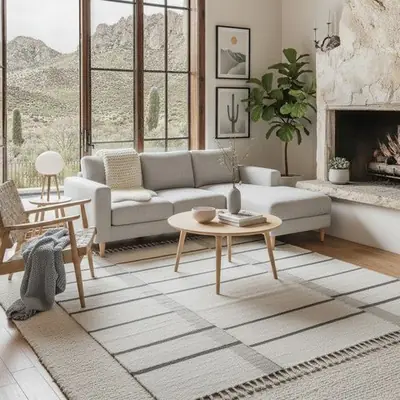
How to make a small room look bigger and brighter
Quick answer
Make a small room look bigger by letting the eye travel without interruption: paint walls, woodwork and ceiling in light, closely related colours, choose fewer but larger pieces raised on legs, lay a rug big enough for the front legs of the seating, hang a mirror where it catches the window, hang curtains high and wide, and light every corner in the evening.

By Eduardo, founder of Calm Decoration
You cannot move the walls, but you can change how far away they seem. This guide gathers the tricks that make a small room feel larger and lighter, explains why each one works, and gives the measurements to get them right. It suits any small room: a living room, a bedroom, a box room or a studio flat.
What makes a room look small?
A room looks small when the eye keeps hitting edges. Every strong contrast line, every cluttered surface, every dark corner and every small piece of furniture dotted around the floor tells your brain where the room ends.
So the aim is not to fill the room with "small-space" furniture. It is to remove interruptions: fewer lines, fewer objects, more visible floor, more light in the corners. Keep that idea in mind and most decisions become obvious.
Which colours make a room look bigger?
Light, closely related colours on the walls, woodwork and ceiling make a room look biggest, because there is no hard line where one surface stops and the next begins. A warm white, a soft stone or a pale grey-green all work, as long as they suit the light (a cool white in a room with cool, indirect light can look grey).
Three ways to use colour in a small room:
- Tonal: walls, skirting and doors in one colour or two very close shades. This is the easiest win.
- Colour drenching: one colour on walls, woodwork and ceiling. The corners blur and the room feels considered rather than cramped.
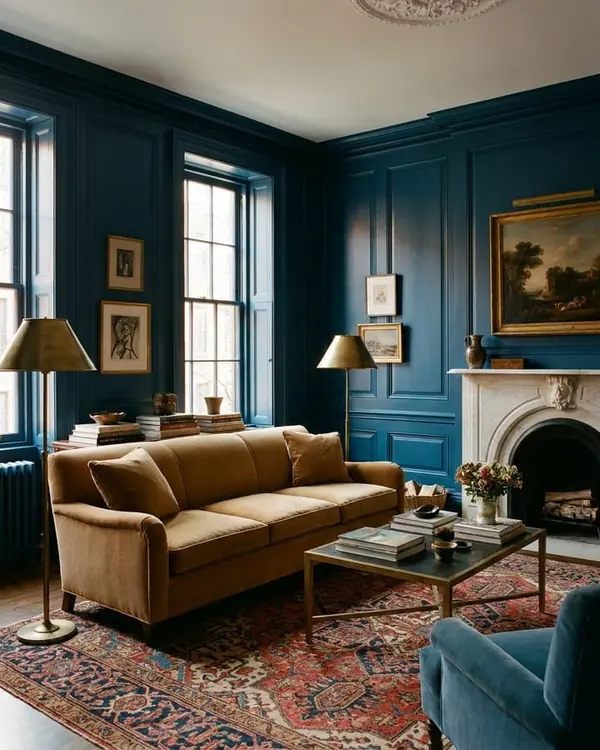
- Deliberately deep: in a room with little daylight, a dark colour on every surface can make the walls seem to recede. It feels cosy rather than big, and it is better than a pale colour that turns dull grey.
Match larger furniture to the walls where you can: a sofa close in colour to the wall behind it seems to take up less space. How to choose paint colours explains how to read your room's light before you pick.
How do you use light to make a room feel larger?
Light the edges of the room, not just the middle. A single ceiling light leaves the corners in shadow, and shadowed corners pull the walls in. A floor lamp in one corner and a table lamp in another push them back.
During the day, let every bit of daylight in. Move furniture away from the window, choose curtains that clear the glass when open, and swap heavy blinds for light linen or sheer fabric where privacy allows. The lighting guide covers bulbs and heights.
Where should a mirror go to make a room look bigger?
Put a large mirror where it reflects a window or a view: on the wall opposite or beside the window. It brings in more daylight and shows something pleasant, which reads as more space.
Avoid placing it where it reflects a cluttered corner, the back of a sofa or a blank wall, which simply doubles what you were trying to hide. One large mirror works better than several small ones; a tall floor mirror leaning against the wall is easy and needs no fixing. A mirrored wardrobe door can do the same job in a bedroom.
Choose furniture that shows the floor
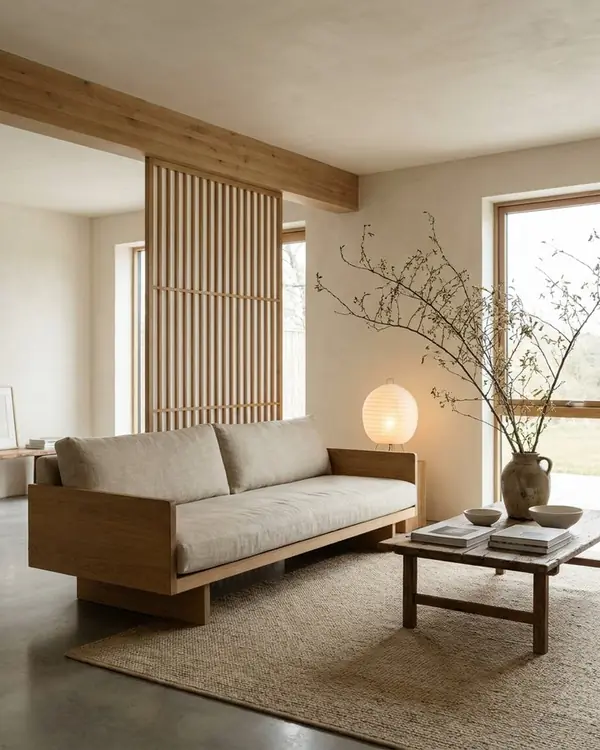
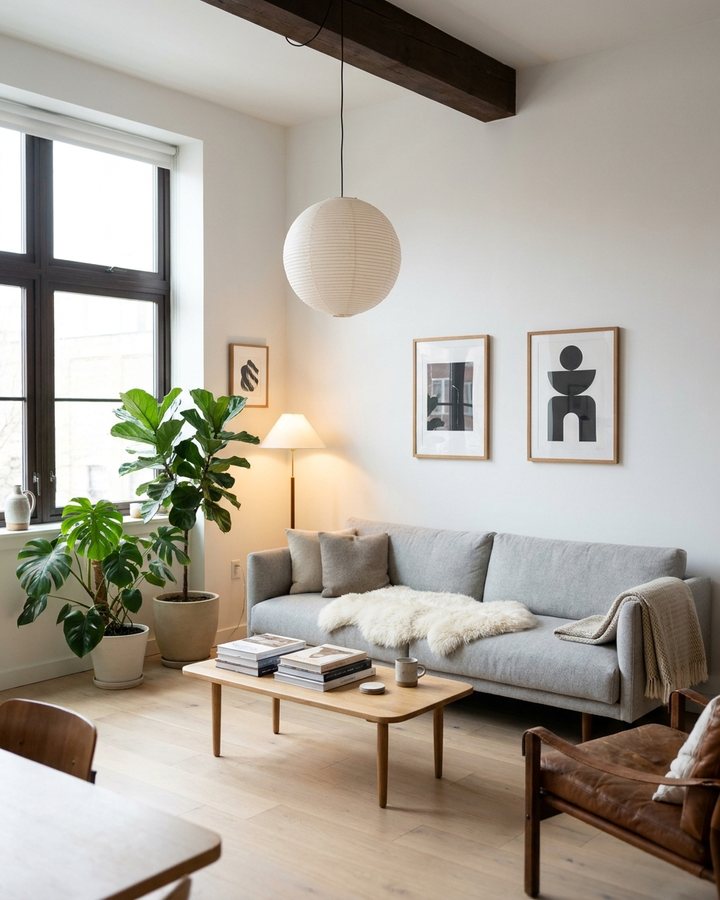
The more floor you can see, the bigger the room looks. That is why furniture raised on legs, as in the room at the top of this page, feels lighter than pieces that sit straight on the floor.
- Raised on legs: sofas, chairs, sideboards and beds with visible legs.
- See-through: glass or acrylic coffee and side tables, open-backed shelves, chairs with open frames.
- Low backs: a sofa that does not block the window or the wall behind it.
- Fewer, larger pieces: one generous sofa looks calmer than a two-seater, two armchairs and a pouffe. Many small pieces create the clutter you are trying to avoid.
- Built-in or wall-hung: a floating shelf or a wall-mounted desk keeps the floor clear.
Scale still matters. Measure before buying, and check how much space you need to walk around each piece. Small living room ideas goes through layouts and furniture sizes for one room in detail.
Hang curtains high and wide
Hang the curtain pole well above the window, closer to the ceiling than to the frame, and let it extend 15 to 30 cm (6 to 12 in) beyond each side. The window then looks taller and wider, and when the curtains are open they cover wall rather than glass, so you keep all the daylight.
Let the curtains reach the floor, and choose a colour close to the walls so they do not cut the room into blocks. The curtain height guide gives the exact measurements.
Pick a bigger rug than you think
A small rug floating in the middle of the floor makes a room look smaller, because it draws a little box inside the big one. Choose a rug large enough for at least the front legs of the sofa and chairs to rest on it. The room then reads as one zone, and the floor seems to continue under the furniture.
In a very small room, a rug close in colour to the floor, or a plain one with texture, keeps it calm. The rug size guide gives sizes for each room.
Draw the eye upwards
Height is space too. Tall, slim shelves, a tall plant, floor-to-ceiling curtains and a pendant that sits close to the ceiling all lead the eye up and make the ceiling feel higher. Vertical panelling or a tall headboard does the same in a bedroom.
Keep anything high fairly light in colour and in look. Heavy dark cupboards at the top of the wall do the opposite.
Keep paths and surfaces clear
A clear path through the room is part of how big it feels. As a rule of thumb, leave about 75 to 90 cm (30 to 36 in) for the main way through a room, and do not let a chair or a side table stick into it.
Edit the surfaces: keep a few things you love out, and the rest in closed storage. Baskets, boxes and cupboards with plain doors do more for a small room than open shelving full of small objects.
A checklist for a small room
| Change | Why it works |
|---|---|
| Walls, woodwork and ceiling in close colours | No hard lines at the edges |
| Light in every corner | Shadowed corners pull walls in |
| Furniture on legs, or see-through | More floor on show |
| Fewer, larger pieces | Less visual clutter |
| A rug under the front legs of the seating | One zone instead of a small island |
| A mirror that reflects the window | More daylight and a view |
| Curtains high and wide | Taller, wider windows |
| Clear surfaces and paths | Calm, easy movement |
This is much of what makes the Scandinavian style feel spacious even in small city flats.
Common mistakes
- Pushing every piece against the walls. A sofa pulled slightly forward, with a slim console behind, can make the room feel more generous.
- Buying tiny furniture. Miniature sofas and doll-size tables make a room look busier and are uncomfortable.
- Too many patterns. One pattern, in a calm colour, is plenty in a small room.
- Blocking the window with a desk, a tall plant or heavy curtains.
- Lots of small pictures. One larger piece of art looks calmer than a scatter of small frames.
Frequently asked questions
Do dark colours always make a room look smaller?
No. In a room with little daylight, a deep colour used on every surface blurs the corners and can make the room feel cosy and less boxy. Dark colours make a room look smaller mainly when they are used on one wall in strong contrast to the others.
Should furniture go against the walls in a small room?
Not always. A gap of even a few centimetres, or a sofa pulled forward to define a seating area, often feels better than everything lined up along the edges like a waiting room.
Does a big sofa make a small room look smaller?
A large sofa that fits the room can make it look bigger than several small seats would, because there is less clutter. Measure carefully and choose one with slim arms and legs.
What flooring makes a room look bigger?
A continuous, light floor running through the room and, ideally, into the next one helps most. Boards laid along the longest direction of the room lead the eye that way.